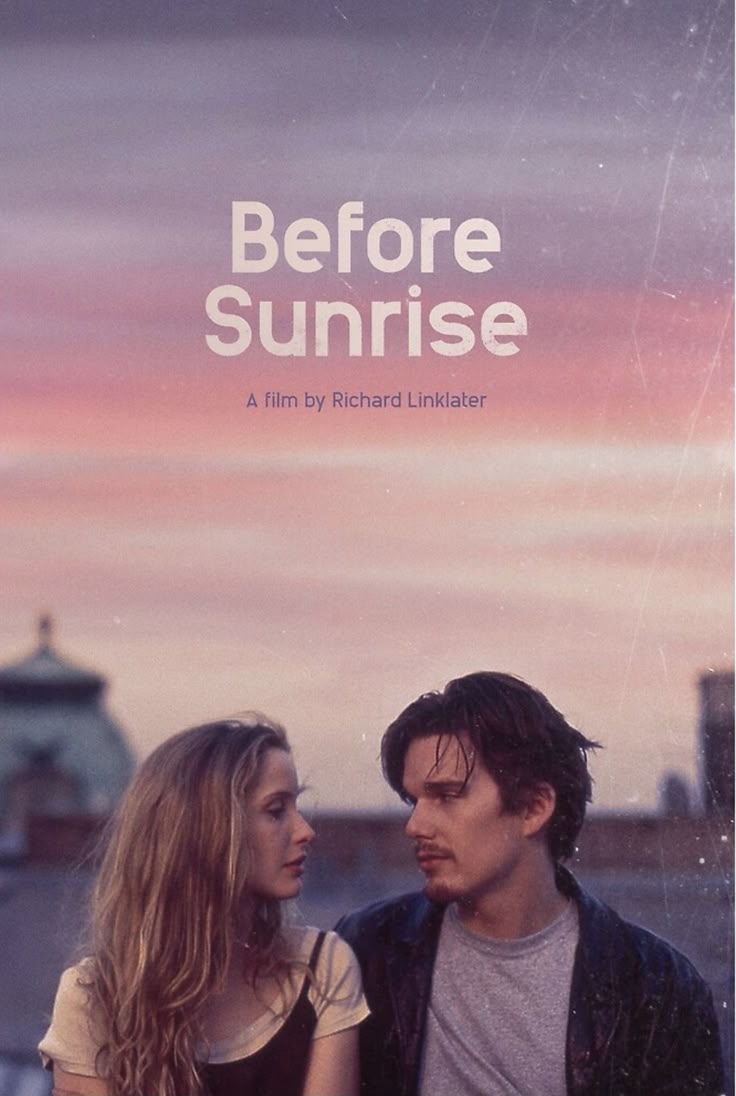
Synopsis
What the film is about
Jesse, an American travelling through Europe, meets Céline, a French student, on a train bound for Vienna. There is an immediate spark between them, but it is not treated like a dramatic movie moment. Instead, it feels organic — a mixture of curiosity, attraction, timing, and that rare sense of ease that sometimes appears between strangers. Before Jesse leaves for his flight the next morning, the two decide to spend one night walking through Vienna together.
What follows is not a dramatic plot in the conventional sense, but an emotional and intellectual encounter that deepens with every street they wander down and every conversation they begin. They move through cafés, parks, record shops, trams, and quiet corners of the city, speaking about love, death, family, memory, spirituality, regret, and the strange performances people put on in everyday life. Their conversation shifts from playful to personal, from philosophical to intimate, without ever feeling forced.
The film becomes less about what happens externally and more about what unfolds between two people when they are fully present with each other. It is about timing, chance, youth, and the beauty of a connection that exists in a suspended moment between reality and imagination. By the end, what seems simple on paper becomes emotionally expansive — a portrait of how one night can alter the emotional shape of a life.
Theme Relevance
Why it belongs here
Before Sunrise belongs in this space because it treats romance as atmosphere, conversation, and emotional recognition rather than spectacle. It aligns beautifully with themes of longing, self-discovery, philosophical intimacy, and the idea that one encounter can leave a permanent mark even if it lasts only a few hours. It understands that emotional closeness is not always built through dramatic events, but through attention — through listening, noticing, wondering, and slowly allowing yourself to be seen.
It also fits alongside films that are interested in mood and interiority. This is not a love story built on grand gestures or neat conclusions. It is built on pauses, eye contact, uncertainty, and the quiet courage it takes to speak honestly with someone you may never see again. That makes it especially fitting for a site shaped by softness, memory, emotional detail, and a cinematic sense of beauty that feels intimate rather than glossy.
More than anything, the film understands the romance of possibility. It is about who we are in moments of openness, and how sometimes the most meaningful connections are the ones that exist without permanence, certainty, or possession. It captures the emotional richness of a moment that is already disappearing even as it is happening.
Emotional Impact
What it evokes
The emotional effect of Before Sunrise is gentle but lasting. It evokes warmth, curiosity, tenderness, and a very particular kind of ache — the ache of knowing that some moments are precious precisely because they cannot be held onto forever. There is a softness in the film that stays with you, not because it asks loudly for emotion, but because it trusts quiet feeling to do the work.
The film stirs romantic idealism, emotional openness, and nostalgia for conversations that seemed to stop time. It makes ordinary places feel charged with meaning, and it reminds you that intimacy can grow through honesty and attention rather than spectacle. There is also a melancholy built into its beauty: the sense that even in the middle of connection, time is already moving forward.
What lingers most is the feeling of emotional suspension. The film leaves you thinking about the people you almost knew forever, the versions of yourself that appeared in fleeting encounters, and the strange beauty of nights that continue to live inside memory long after they end. It does not just evoke romance — it evokes the fragility of being fully alive in a moment you know cannot last.
Longing
Tenderness
Curiosity
Nostalgia
Romantic idealism
Critical Review
How critics responded
Critics have long admired Before Sunrise for its natural chemistry, intelligent dialogue, and deceptively simple structure. The film is often praised for making conversation feel cinematic — turning wandering discussion into something emotionally compelling, intimate, and unexpectedly profound. It has also been recognized as the first film in Richard Linklater’s Before trilogy, with Ethan Hawke and Julie Delpy’s performances frequently singled out as central to its appeal. :contentReference[oaicite:2]{index=2}
Reviewers frequently highlight the elasticity of the performances and the warmth of the writing, which feels spontaneous and philosophical without becoming cold or overworked. The film resonates both as a romance and as a reflection on time, youth, and the fragile intensity of brief encounters. Part of its lasting power comes from how little it forces. It allows meaning to emerge naturally, which is exactly why it continues to feel intimate decades later. :contentReference[oaicite:3]{index=3}
Critics often point to the film’s rare ability to make a brief encounter feel expansive, memorable, and emotionally complete without forcing it into melodrama.
Trailer
Watch the trailer