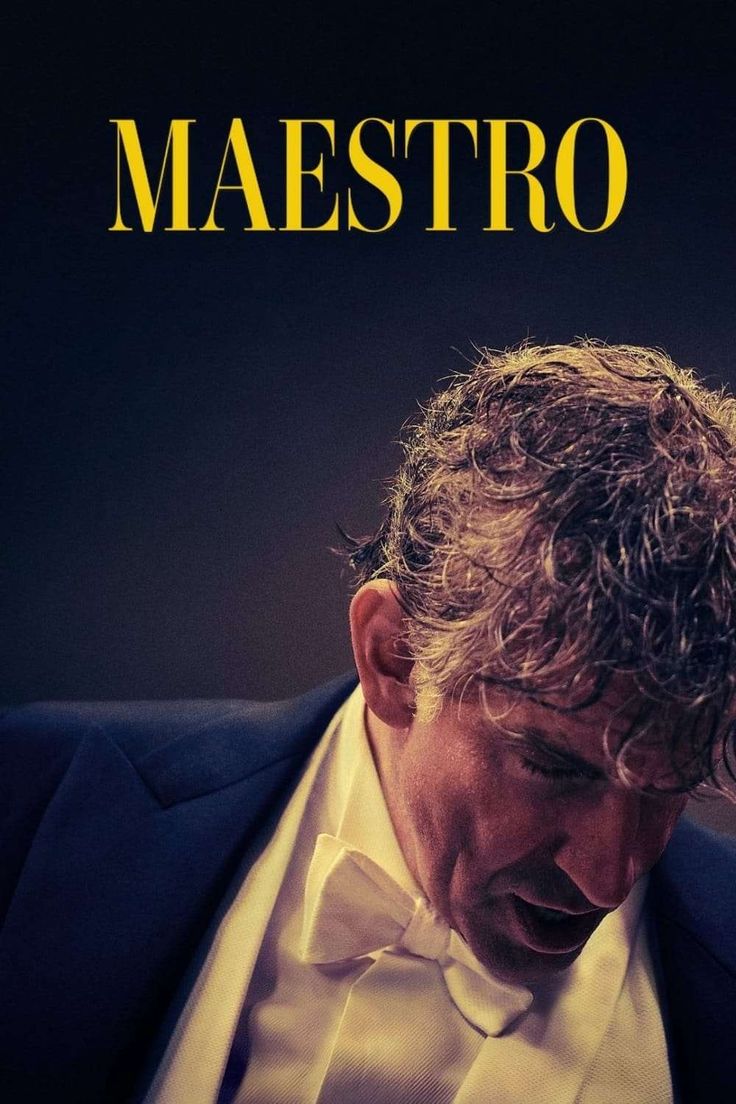
Synopsis
What the film is about
Maestro traces the relationship between composer-conductor Leonard Bernstein and actress Felicia Montealegre across decades of marriage, family life, artistic success, and emotional complexity. Rather than functioning as a conventional cradle-to-grave biopic, the film focuses more intimately on their bond — how it begins, how it deepens, how it strains, and how it survives within a life shaped by public visibility and private contradiction. :contentReference[oaicite:1]{index=1}
Bernstein is presented not only as a celebrated artist, but as a man whose charisma, ambition, sexuality, and appetite for life make him both magnetic and difficult to contain. Felicia is not framed simply as the woman beside him, but as someone whose intelligence, love, compromise, and emotional endurance are central to the shape of the story. Their marriage becomes the space where admiration, resentment, tenderness, performance, and sacrifice all intersect.
The film moves across time, showing how artistic legacy and domestic intimacy can become entangled in painful ways. It pays close attention to the emotional cost of loving someone who belongs partly to the world, and to the negotiations required when image, fidelity, family, and public identity do not align neatly.
Rather than building toward a single revelation, the story accumulates emotional meaning through scenes of performance, conflict, distance, and care. What emerges is less a neat biography than an examination of marriage as an evolving and often contradictory form of devotion.
Theme Relevance
Why it belongs here
Maestro belongs here because it explores love through elegance, restraint, and emotional contradiction. It aligns with themes of marriage, artistic identity, performance, longing, public image, and the emotional cost of loving someone complex and expansive. Like other works in your archive, it is interested not just in romance, but in the tension between who people are privately and who they must appear to be in the world.
It also fits because of its visual and emotional sophistication. The film is formal, polished, and deliberate, but not emotionally cold. Its beauty is part of its meaning. Concert halls, private rooms, clothing, movement, and staging all contribute to the feeling that life itself is being choreographed, even while the emotional truth underneath remains unstable.
More than that, the film belongs in this collection because it understands that intimacy is often shaped by performance. Not falsehood exactly, but performance in the sense of role, presentation, containment, and emotional management. The people in Maestro love each other deeply, but that love exists alongside compromise, imbalance, and the difficulty of making a life around someone whose identity exceeds the domestic frame.
Within your archive, it becomes one of the most mature and formally elegant portraits of love — less chaotic than Closer, less soft than Normal People, but deeply resonant in the way it treats partnership as something beautiful, painful, enduring, and impossible to simplify.
Emotional Impact
What it evokes
The emotional impact of Maestro is refined but heavy. It evokes admiration, ache, distance, tenderness, melancholy, and the strange loneliness that can exist inside a lifelong bond. Unlike films that build intensity through overt emotional collapse, this one often works through restraint — through glances, pauses, formal settings, and the emotional tension between what is performed and what is felt.
The film also evokes the sadness of asymmetry in love: the feeling that two people can be deeply committed to one another while still carrying profoundly different burdens inside the same relationship. That gives the story an adult sadness — not one rooted in a single betrayal or rupture, but in the accumulation of years, choices, concessions, and unresolvable contradictions.
There is also something haunting in the way the film connects beauty to emotional difficulty. Music, status, genius, and visual elegance do not protect the characters from pain; if anything, they intensify it. The grandeur of the world around them only throws their private emotional fractures into sharper relief.
What lingers most is the feeling of loving someone whose brilliance is inseparable from their difficulty — and the realization that devotion can remain real even when it is tested by imbalance, performance, and emotional cost.
Elegance
Melancholy
Marriage
Performance
Longing
Critical Review
How critics responded
Maestro drew praise for Bradley Cooper’s direction and performance, along with strong acclaim for Carey Mulligan’s portrayal of Felicia. It was widely discussed as an ambitious and emotionally charged film, and it went on to receive major awards attention. :contentReference[oaicite:2]{index=2}
Critics often highlighted the film’s technical ambition, visual formality, and emphasis on the complexity of marriage rather than a more straightforward “great man” biopic structure. Netflix and related coverage also frame it explicitly as a love story centered on Bernstein and Montealegre’s lifelong relationship. :contentReference[oaicite:3]{index=3}
What makes the film memorable is the way it turns marriage, art, and public image into one shared emotional stage — beautiful, demanding, and deeply unstable.
Trailer
Watch the trailer